
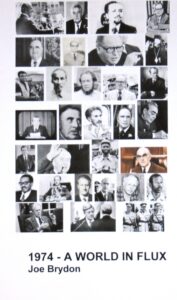
Critical international events in 1974 included coups in Ethiopia, Portugal and Uruguay, Nixon’s resignation over Watergate, the restoration of democracy in Portugal and Greece, Turkey’s invasion of Cyprus and the imminent collapse of South Vietnam. Britain re-negotiated its membership of the EEC and the inter-dependence of nations was evident.
Economies were stalling too – in that instance as the OPEC oil price rises of 1973 worked their way through.
This book tackles the global implications then and the similarities and contrasts with today. The final chapter includes a postscript on the co-operative, multinational approaches that will be required to tackle climate change and were required for Covid-19. It is instructive that many market economies had to re-adjust their values and priorities to cope with the coronavirus pandemic. In 1974 many nations took that approach as read.
CONTENTS
| 1974 calendar of events | |
| 1 | Introduction: A world in flux then |
| 2 | In or out? Britain and the EEC |
| 3 | Minority communities and intervening, or failing to: Cyprus, Rhodesia and Northern Ireland |
| 4 | The centre cannot hold: Imperial decline in Ethiopia and empire decline in Angola, Mozambique and Vietnam |
| 5 | Against the odds: The US illusion exposed |
| 6 | State prerogative: Repression at home and détente abroad – The Soviet Union and the Eastern bloc |
| 7 | Political change in Western Europe: Greece, France, West Germany and Portugal |
| 8 | Austria: Straddling all divides (north-south, east-west) |
| 9 | Central and South America: Civil disorder and repression (Uruguay, Chile, Colombia, Bolivia, Guatemala) |
| 10 | Liberal resurgence: Canada and Australia |
| 11 | Under the ground: Oil and OPEC/Middle East muscle |
| 12 | Lessons for the future: A world in flux now |
| Appendix: UN member countries in 1974 by continent | |
| Notes | |
| Bibliography | |
| Index – by place; by people | |
| Photographs on front cover |